
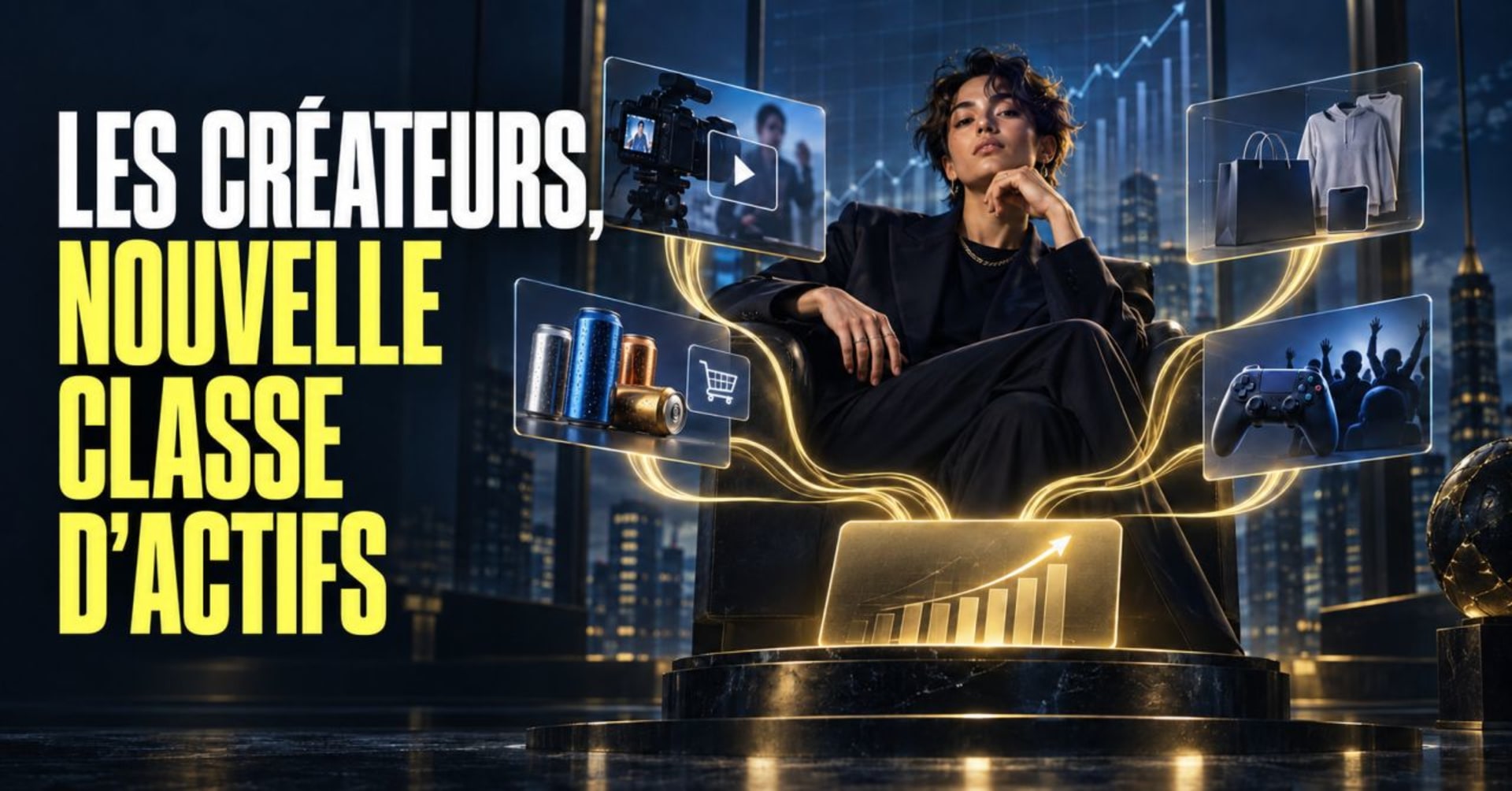
Creators are becoming a new financial asset class. CreatorFi has just raised $45 million to finance businesses built around talent, audiences and content. When finance starts taking a market seriously, that market has usually already changed dimension.
CreatorFi raises $45 million to finance creators
The principle is simple: CreatorFi advances between $500,000 and $5 million to creators who already generate recurring revenue — YouTube advertising, Spotify royalties, TikTok Shop sales, Roblox earnings. In exchange, the company collects a share of their future revenue.
This is neither a classic equity investment nor a traditional bank loan. It is financing backed by existing revenue streams.
Venture capital and debt: two different financing logics
Equity investors usually bet on a company, its product, its team and its growth potential. They buy a piece of the future, with the risk that this future never arrives.
Lenders, on the other hand, mostly look at what secures their money: assets, contracts or revenue regular enough to predict how they will be repaid. They finance what they can measure.
That is exactly where the shift happens. Until now, a creator's revenue was considered too volatile, too dependent on an algorithm or a single person, to fall into that category. That is no longer the case.
What CreatorFi actually finances: revenue that already exists
CreatorFi doesn't bet on a promise, but on existing, recurring revenue:
- YouTube advertising;
- Spotify royalties;
- TikTok Shop sales;
- revenue generated on Roblox.
To decide, the company analyzes four criteria: revenue, audience loyalty, operator quality and the ability to create new intellectual property. These are exactly the questions any financier asks about any business: does it earn, does it last, who runs it, and what comes next?
Can a YouTube channel be a financial asset?
That is the real question raised by this type of financing. And CreatorFi's answer is yes: a YouTube channel, a music catalog, a game or a loyal community can produce revenue predictable enough to be financed.
The logic isn't entirely new. Buying and financing music catalogs has long relied on the same reasoning: rights that generate regular, modelable revenue. What changes is the scope. We are no longer talking only about copyright, but about audiences, communities and formats native to the platforms.
Why finance stepping in is a strong signal
Structuring financing requires data, track records, valuation methods and a minimum level of confidence in the durability of the revenue. If financial players agree to take that risk, it means the substance is there.
In other words: the creator economy is no longer assessed as a trend, but as a measurable economic activity. That's a change of status more than a change of scale.
And it may also make possible fiascos like Khaby Lame's.
The risks of a model backed by attention
Financing audience revenue remains a bet on a fragile balance. Three risks compound:
- Platform dependence. A change in algorithm or monetization policy can shift revenue overnight, without notice or recourse.
- Concentration on one person. Unlike a company, an audience often rests on a single individual, with everything that implies in the event of a crisis, fatigue or withdrawal.
- Selling future revenue in advance. Giving up a share of upcoming revenue can weaken a creator if their trajectory slows, turning financing into a lasting constraint.
The value of an audience can turn around fast. That's the flip side of an asset whose worth ultimately depends on the attention of a public.
What this changes for brands
For brands, the consequence is direct. Tomorrow, the most powerful creators will no longer be just communication partners. They will also be producers, media outlets, distributors and sometimes competitors.
A creator able to raise financing no longer needs an advertiser in order to produce. They can develop their own formats, their own products, their own sales channels. The relationship stops being asymmetrical.
This calls for rethinking how these partnerships are approached: less as buying media space or commissioning a service, more as a negotiation between economic players who each hold their own assets, audience and production capacity.
In summary
CreatorFi raised $45 million to advance between $500,000 and $5 million to creators with recurring revenue (YouTube, Spotify, TikTok Shop, Roblox), in exchange for a share of their future earnings. This model treats an audience as a financeable asset, in the same way as a music catalog. The arrival of financial players signals that the creator economy is now considered a measurable economic activity. For brands, it changes the balance of power: creators become producers, media outlets and sometimes competitors.
FAQ
What is CreatorFi?
CreatorFi is a financing company dedicated to content creators. It raised $45 million to finance businesses built around talent, audiences and content, advancing between $500,000 and $5 million per deal.
How does financing a creator against future revenue work?
The financier advances a sum to a creator who already has recurring revenue, then collects a share of their upcoming earnings until repayment. It takes no equity stake: it is backed by existing revenue streams.
Why are creators becoming an asset class?
Because their revenue has become regular and measurable enough to be modeled: advertising, royalties, platform sales. A financier can therefore estimate repayment, which was impossible while that revenue was considered too volatile.
What are the risks of this financing model?
Mainly platform dependence (an algorithm change alters revenue), concentration on a single person, and selling a share of future revenue in advance, which can weaken the creator if their trajectory slows.
What does this change for brands?
Financed creators can produce without an advertiser. They become producers, media outlets, distributors and sometimes competitors. Brands must therefore move from buying media space to partnering between economic players.
And you — do you still see creators as simple communication partners? Let's talk about it.