
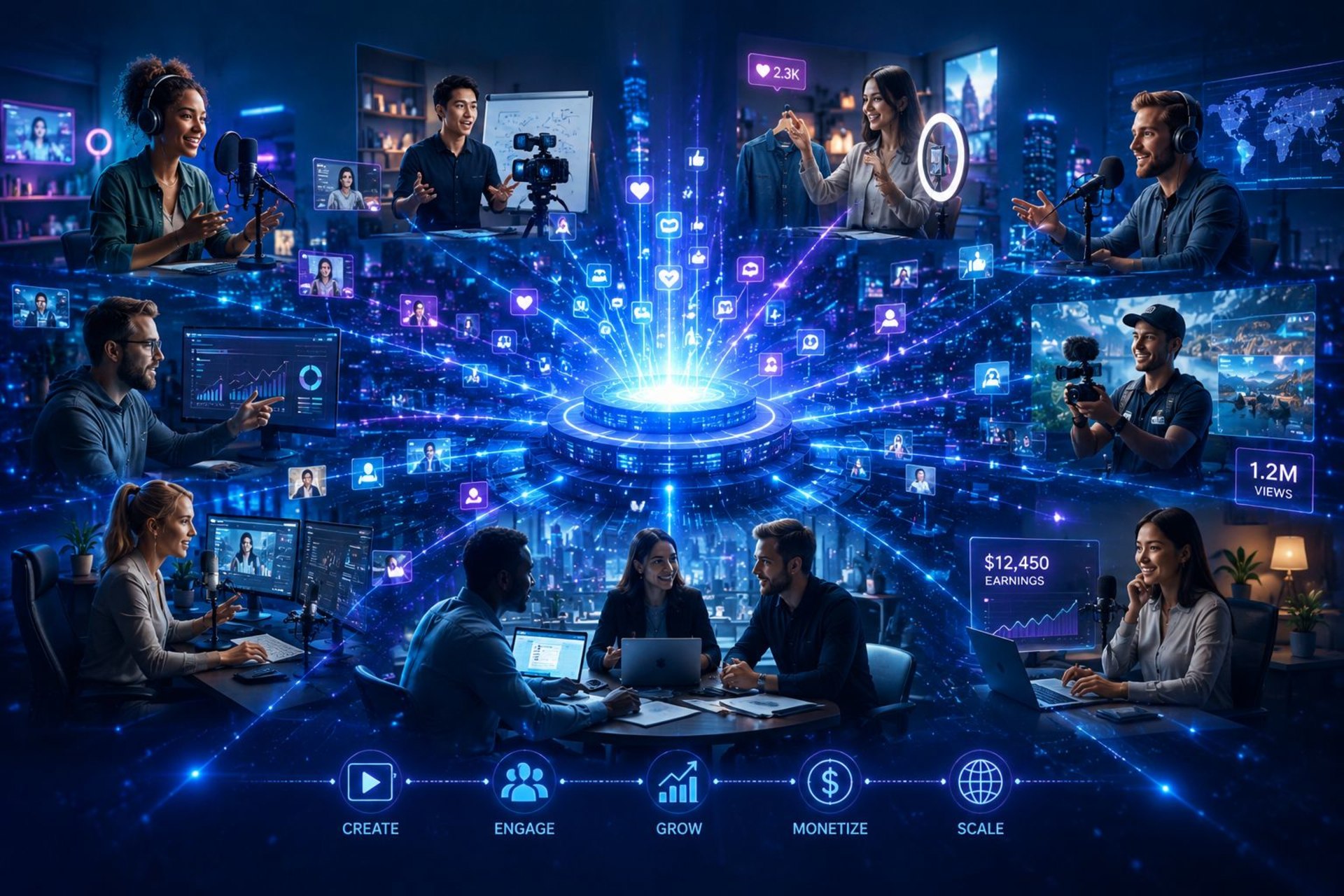
Creators are no longer just profiles you activate to gain visibility. They have become media outlets, distributors, trusted third parties and sometimes even entrepreneurs capable of turning an audience into a community, and a community into a business. For brands, the question is therefore no longer: "Which influencer can talk about us?" but: "What ecosystem of credible voices should we build around our brand?"
Creators have changed the rules of the game
For a long time, brands thought of creators as an extension of their campaigns: a brief, a post, a story, a promo code, and then on to the next one. That model is becoming insufficient.
Creators today can capture attention, explain a product, build trust, sell, nurture a community and give a brand cultural relevance. They are no longer just a distribution channel: they are becoming a media layer in their own right.
The creator economy is no longer a test, it's a media channel
The numbers confirm the shift. According to the IAB, U.S. advertising spend tied to the creator economy grew from $13.9 billion in 2021 to $29.5 billion in 2024, with projections of $37 billion in 2025 and $44 billion in 2026. The IAB also reports that nearly half of media buyers now consider creators a "must buy" channel, just behind search and social media.
This change is strategic: brands are no longer "testing" creators. They are integrating them into their media mix, their acquisition strategy, their content strategy and sometimes their commercial strategy.
The next step: from one-off influence to an ecosystem of voices
The real evolution isn't simply working with more creators. It's about better organizing the voices around the brand. An ecosystem of voices can include:
- external creators;
- subject-matter experts;
- executives and founders;
- employee ambassadors;
- customers;
- specialized communities;
- niche media or podcasts.
The challenge is therefore no longer just to pick "the right influencer", but to build a coherent editorial architecture across all these voices.
Employees are becoming creators too
One of the interesting signals of the creator economy is the rise of employee advocacy. Retailers, service brands, B2B companies and institutions no longer rely solely on external influencers. They are also turning some of their employees into ambassadors.
Why? Because a salesperson, a product expert, an advisor, an engineer or an executive can sometimes be more credible than an ad. The content then becomes closer, more embodied, more educational.
The creator economy is also becoming an economy of expertise
The creator economy no longer concerns only fashion, beauty, gaming or entertainment. We are seeing creators emerge in far more "serious" sectors: health, finance, law, real estate, education, AI, industry, management, human resources. Doctors, lawyers, bankers, physiotherapists, researchers, executives and consultants are building audiences around their expertise.
This is a major shift for B2B brands: the message no longer rests solely on the corporate brand, but on expert personalities capable of making a complex subject desirable, clear and shareable.
AI accelerates the creator economy, but does not replace human trust
AI makes it possible to produce faster: scripts, formats, variations, editing, subtitling, monitoring, translation, content recycling. But it also makes the human voice more valuable.
The IAB observes that three quarters of brands already use or plan to use AI for creator-marketing tasks. But the same report stresses that brands still need to make progress on measurement, standards and operational tools.
The challenge, then, is not to replace creators with AI, but to augment them: better spotting topics, producing more efficiently, adapting formats, measuring performance, all while keeping an identifiable human voice.
Creators are entering the industry's flagship events
The creator economy is now at the center of major marketing events. Cannes Lions launched LIONS Creators, a program dedicated to the "business of influence", held from June 22 to 26, 2026 in Cannes, with spaces, talks, workshops and meetings between creators, brands and decision-makers.
Another sign that creators are becoming an industry in their own right: VidSummit, one of the leading U.S. gatherings for YouTube creators and video professionals, will take place from September 29 to October 1, 2026 in Dallas. The event shows that the creator economy is now structured around highly business-oriented topics: audience growth, monetization, brand partnerships, operations, AI and revenue diversification.
The creator economy transforms three essential dimensions
The creator economy transforms three essential dimensions: communication, distribution and credibility.
Brands can no longer simply buy visibility. They must build networks of trust. That means working with external creators, but also surfacing internal voices: executives, experts, employees, founders, customers, partners.
The future of brand communication will be less vertical, less institutional, less campaign-centric. It will be more embodied, more distributed, more conversational.
In summary
The creator economy refers to the economy driven by content creators, influencers, experts, communities and personalities able to turn an audience into economic value. For brands, it represents a new media channel, but also a new model of trust. Creators are no longer just advertising relays: they become partners in content, distribution, commerce and credibility.
FAQ
What is the creator economy?
The creator economy is the set of economic activities generated by content creators, their audiences, their communities, their partnerships with brands, their products, their media and their monetization models.
Why is the creator economy important for brands?
Because it allows brands to reach consumers through voices that are more human, more credible and closer to how people actually use social platforms.
What's the difference between influencer marketing and the creator economy?
Influencer marketing often consists of activating profiles to promote a brand. The creator economy is broader: it encompasses content creation, audience building, monetization, social commerce, personal media, communities and expert creators.
Why are employees becoming brand ambassadors?
Because they embody a more authentic and more expert voice. In some sectors, an employee, an expert or an executive can be more credible than a classic advertising message.
What role does AI play in the creator economy?
AI accelerates production, monitoring, editing, translation and content variations. But trust, embodiment and legitimacy are still carried by humans.
And you — has your brand built its ecosystem of voices? Let's talk about it.